Explainer · 2026
How Do Hotel Key Cards Work?
What the front desk writes, what the lock checks, RFID versus LoCo stripe keys, and the five reasons a hotel key stops working.
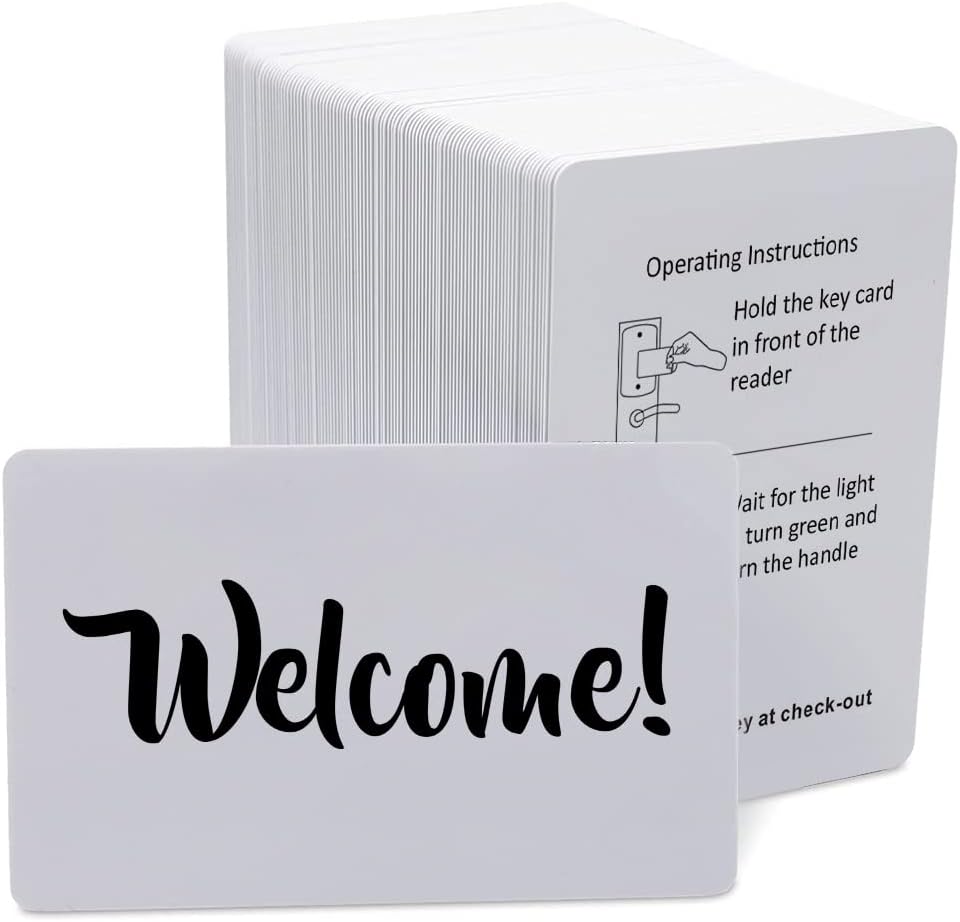
A hotel key card looks like a blank piece of plastic, and in a sense it is. It only becomes a room key when the front desk writes it, and it stops being one when the stay ends. This post explains what happens at check-in, at the door and at check-out, why keys stop working, and what that means for a property ordering them. It sits alongside our guide to access credentials and encoding, which covers the card technologies themselves.
The front desk writes the key
Every hotel with electronic locks has an encoder at the front desk, connected to the lock system's software. At check-in, the desk tells the software which room and how long the stay is, and the encoder writes that onto a blank key.
What exactly goes on the key depends on the lock system, but it is typically the room, or rooms, the key opens and the window in which it is valid. Some systems add access to shared doors such as the pool, gym or parking garage.
That is why the same blank card can be any room's key. The card does not belong to a room until it is written, and a returned key can be written again for the next guest.
The lock checks the key
Each door lock is a small, battery-powered computer that knows its own room and the current time. When a guest taps or swipes a key, the lock reads what the encoder wrote and checks two things: is this key for this door, and is it still within its valid period. If both are true, the lock opens.
The lock usually does not need a network connection to do this. The rules are carried on the key and checked against the lock's own settings, which is why a lock can keep working through a network outage.
RFID keys and magnetic stripe keys
Hotels use one of two kinds of key, and the lock decides which.
- RFID keys carry a small chip, usually MIFARE Classic 1K, and guests tap them on the lock. There is no stripe to wear out or wipe, so they last longer. Most newer installations use them.
- Magnetic stripe keys are swiped or inserted. Hotel encoders write low-coercivity, or LoCo, stripes, which are easy to write and rewrite. Many properties still run magnetic locks, and they work well.
The two are not interchangeable. An RFID lock will not read a stripe, and a magnetic lock will not read a chip, even when a card carries both.
Why hotel keys stop working
When a guest comes back to the desk with a key that will not open the door, it is almost always one of these:
- The stay was extended. The key was written for the original checkout, so it expired on schedule. It needs to be written again with the new date.
- A newer key was issued. On many systems, writing a new key for a room cancels the older ones. If a second key was made later, the first may stop working.
- The stripe was wiped. LoCo stripes are easy to write, which also makes them easy to wipe. Magnetic phone cases, bag clasps and a key kept next to a phone are the usual causes. RFID keys do not have this problem.
- The card is damaged. A cracked card can break the chip's antenna inside it, and a scratched stripe will not read.
- The lock itself. A low lock battery or a lock with the wrong time can reject good keys. That one is for maintenance, not the desk.
In almost every case, the fix is to write the key again at the desk.
Returned keys can be used again
A key that comes back to the desk is not waste. Because the encoder writes each key fresh at check-in, a returned key can be written for the next guest as long as it is clean and undamaged.
- RFID keys can be rewritten many times. A collection box at the desk and in the lobby pays for itself.
- Magnetic stripe keys can be rewritten too, until the stripe is scratched or worn. Check that a returned key reads cleanly before it goes back in the drawer.
- Cracked or bent keys should be thrown out, since a damaged RFID key can fail partway through a stay.
Reusing keys cuts the order size, but it never removes the need to order. Some keys always walk out the door.
What about phone keys?
Many hotel brands now let guests open their room with a phone. That changes less than it might seem for most properties. Phone keys depend on the guest using the brand's app or wallet pass, and on locks that support it. Most properties that offer them still issue plastic keys to every guest who wants one, and keep plastic as the backup when a phone battery dies.
For an independent or older property, plastic keys remain the whole program. For a branded one, they are still the most common key handed across the desk.
Why properties go through so many keys
Guests take keys home, lose them, leave them in rental cars and ask for second ones. Even with a collection box at the desk, a property issues far more keys than it has rooms, which makes keys a consumable to plan for, not a one-time purchase.
The simplest way to size an order is to count how many keys the desk writes in a typical month, over a few months, and order several months ahead of that rate, with extra before the busy season.
Choosing keys for your property
The lock system decides the key, so start there. Check a current key with a free NFC reader app such as NXP's TagInfo: if it reports MIFARE Classic 1K, that is the card we supply. If it shows nothing, your keys are probably magnetic stripe, and they should be LoCo.
From there, it is a choice between stock keys with a generic Welcome design and custom-printed keys with your property's artwork, which start at 500 keys. Our hotel key cards page covers both, and our hospitality page covers staff badges and the rest of a hotel's card program.