Role Recognition
Badge Buddies
Oversized color-coded role cards that hang behind the ID badge, so RN, STUDENT, SECURITY or VISITOR reads from across a room. Standard roles or printed to your own scheme. Authorized Brady dealer.
Request a quote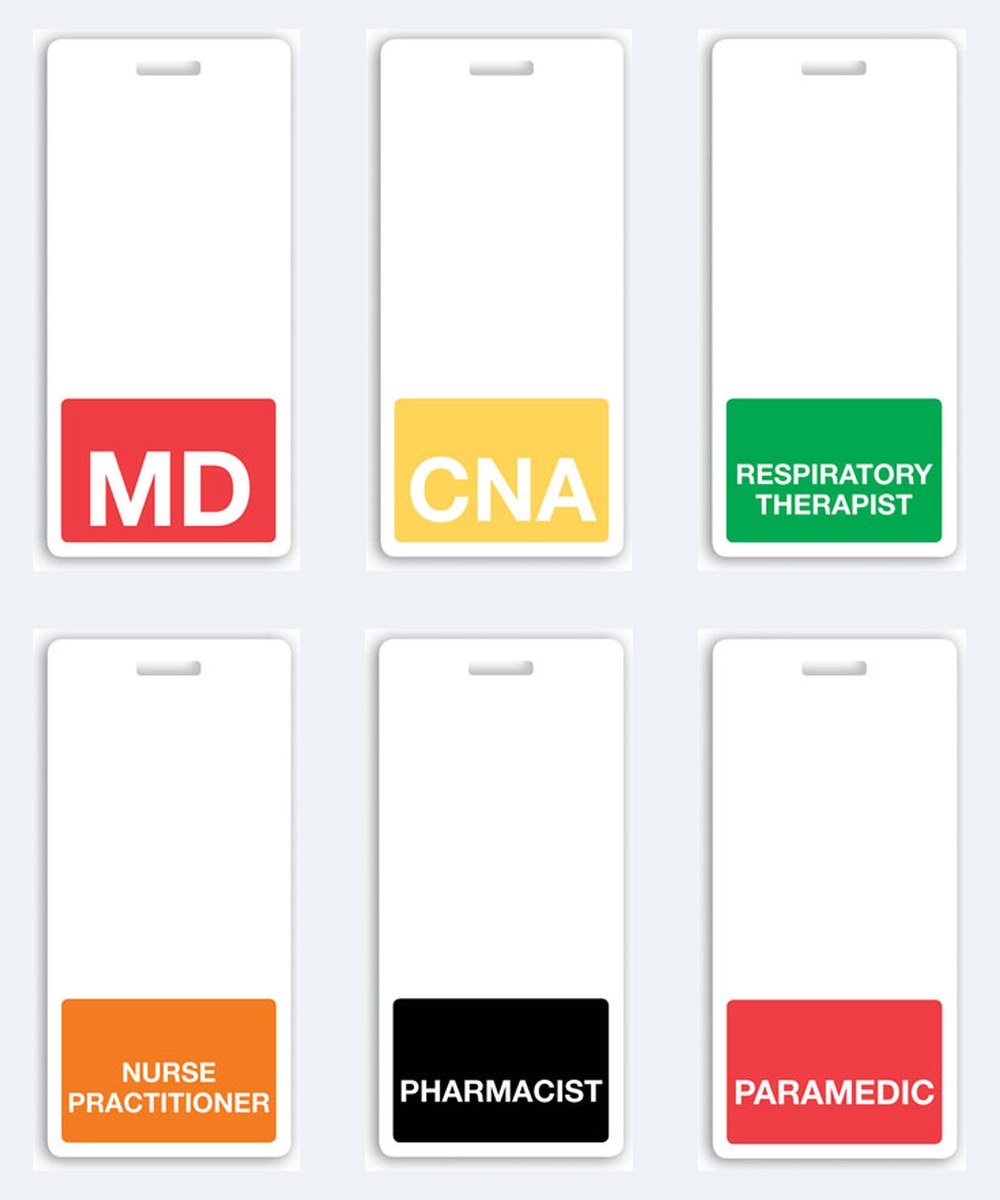
A badge buddy is the oversized, color-coded card that sits behind an ID badge so the person's role can be read from across a room. The name badge answers "who is this," which matters at arm's length. The badge buddy answers "what are they," which is the question people are actually asking from ten feet away, usually at the worst possible moment. We are an authorized Brady dealer, and Badge Buddy is a Brady People ID line, so we can quote them stock or printed to your own role scheme. Everything here is quoted to order: tell us your role list and we will price it properly.
What a badge buddy actually does
Stand in a hospital corridor and look at the badges going past. A standard CR-80 card is 3.375 by 2.125 inches, and the job title on it is set in about ten point type. At conversation distance you can read it. At the far end of a hallway, in a crowd, or from a bed, you cannot read any of it, and neither can a patient, a parent, a contractor or a police officer.
A badge buddy solves that by being bigger than the badge and carrying one word in large, high-contrast type on a color background. It hangs behind the ID card on the same lanyard or reel, so the badge still does its job up close while the buddy does the long-distance job. Nobody has to change what they wear or how they clip it on.
The other thing it does, quietly, is make the role harder to misread. A stranger in scrubs is ambiguous. A stranger in scrubs with no role card, in a building where every clinician wears one, is not.
Nurse badge buddies, and the credential ladder people need to read
Healthcare is where this started and where the demand still is, because healthcare is the one workplace with a dozen licensure levels that all look identical in uniform. A patient's family cannot tell an RN from an LPN from a CNA from a nursing student from a phlebotomist, and in most cases they do not know those distinctions exist. They just want to know who can answer the question they are about to ask.
A nurse badge buddy makes the ladder legible. The common ones are:
- RN, registered nurse, usually the most-issued card in the building.
- LPN or LVN, depending on your state's terminology.
- CNA or PCT, nursing assistants and patient care technicians.
- NP, MD, DO and PA for the prescribing tiers.
- STUDENT, which is the one most worth getting right, because a student in scrubs is indistinguishable from staff and the confusion runs in both directions.
- Support roles that families often mistake for clinical staff: RT, PT, OT, DIETARY, ENVIRONMENTAL SERVICES, SECURITY, CHAPLAIN, VOLUNTEER.
One thing worth checking before you order: some states have practitioner identification requirements that specify what a healthcare worker's badge has to display and how legibly. Whether one applies to you is a question for your compliance people rather than for us, but it is worth asking before you settle a design, because it is far cheaper to answer now than to reprint a thousand cards later.
The same problem outside healthcare
Role recognition is not a hospital idea, it is a crowd idea, and it shows up anywhere people who look alike have very different permissions.
Schools and universities use them for staff, substitute teachers, student teachers, contractors and parent volunteers, so anyone in a hallway can tell at a glance whether an adult is supposed to be there unescorted. Manufacturing and warehousing use them for trained forklift operators, first aid responders, confined space entrants and anyone whose training has to be visible to a supervisor across a plant floor. Events and conferences use them for staff, speakers, press, exhibitors and attendee tiers, which is the same job a colored ribbon does badly. Government and municipal offices use them for employees, contractors and elected officials in buildings the public walks into.
The test is simple. If somebody has to ask "are you the person I need," a role card would have answered it.
Pick your role names before you pick your colors
Almost everyone does this in the wrong order. Colors get chosen first, because colors feel like the interesting decision, and then it turns out there are fourteen roles and about eight colors that actually read as distinct from a distance.
Start with the list of roles instead. Write down every one, then cut the list by asking one question about each: does anyone outside this department need to tell this role apart from the one next to it? If the answer is no, the two share a card. A program with six clear roles works. A program with nineteen becomes wallpaper and people stop reading it, which is worse than not having one at all.
Then assign colors, and know going in that there is no national color standard. No governing body says RN is navy. Every organization sets its own scheme, which means two things: you are free to choose, and you should write the scheme down somewhere permanent, because the person who picked the colors will eventually leave and somebody will have to order the next batch.
There is more to this than fits on a product page, so we wrote the long version: badge buddy colors and roles covers how to cut a role list down, the legibility math for reading distance, designing around color vision deficiency, and how to document a scheme so the next order is right. If you are setting one up from scratch, read that first.
A few things that make a scheme hold up:
- Contrast beats color. From twenty feet the eye reads the light-dark difference before it reads the hue, so a dark card with white text and a light card with dark text will both outperform two mid-tone colors sitting next to each other.
- Do not put your two most safety-critical roles on colors that differ only in hue, like red and green. Roughly one in twelve men has some degree of color vision deficiency, and they are on your staff.
- Reserve one loud color for the role you most need people to spot instantly, usually security, a code responder, or a visitor who should be escorted.
- Keep the word large and keep it short. Two syllables that fill the card beat a full job title that has to shrink to fit.
Vertical or horizontal is decided by the punch you already use
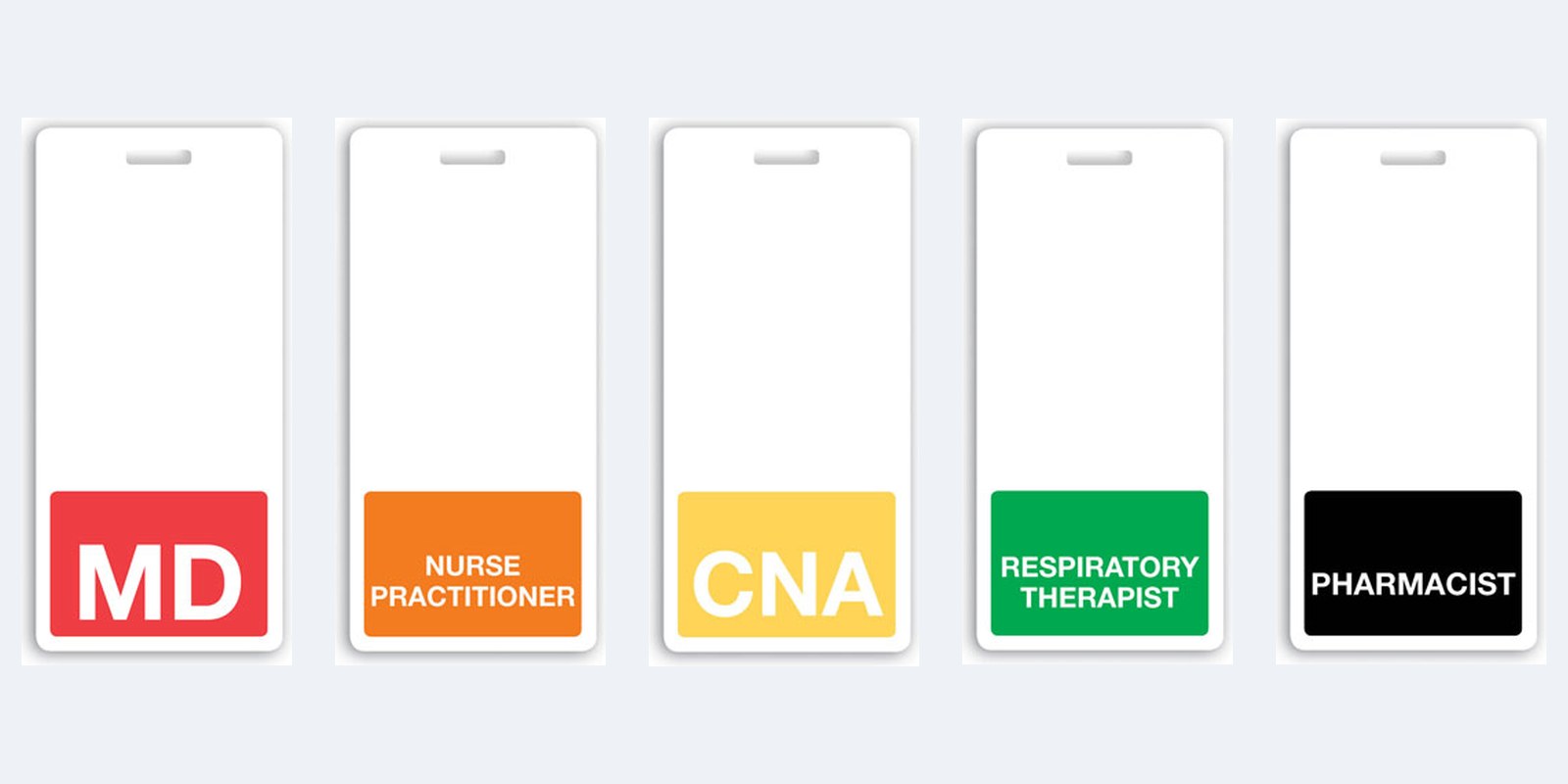
Badge buddies come in vertical and horizontal versions, and this is not an aesthetic choice. It follows the badge, and the badge follows the slot punch.
The two sizes are fixed, and they explain the design better than any description does. A vertical badge buddy is 2-1/8 inches wide by 4-1/2 inches tall. A horizontal one is 3-3/8 wide by 3-3/32 tall. Set those against a CR-80 badge, which is 3.375 by 2.125 inches, and the logic falls out: in both orientations the badge buddy is exactly as wide as the badge hanging in front of it, and about an inch to an inch and an eighth longer. The badge covers the top of it, and the colored bar at the foot is the only part anyone sees. That is why the role word sits at the bottom of the card rather than the middle, and it is the thing to keep in mind if you are art-working a custom one.
If your cards are punched at the short end and hang portrait on a lanyard or reel, you need vertical buddies, because the buddy has to hang the same way behind the same slot. If your cards are punched along the long edge and hang landscape from a clip, you need horizontal. Mixing them means a buddy hanging sideways behind a badge, which looks exactly as bad as it sounds and is the single most common thing to get wrong on a first order.
If you are not sure which you have, take a photo of a badge somebody is actually wearing and send it over. That answers it in ten seconds, and it is a much better question to ask before the order than after. If you are setting up a badge program from scratch and have not settled the punch yet, our badge accessories page walks through the orientation decision in the order it is really made, and it is worth reading before you finalize card artwork, since the design has to leave the slot area clear either way.
Standard roles, or printed to your own scheme
There are two ways to buy these and the right one depends on how standard your roles are.
Standard role cards carry the common titles in established colors and are the fast path when your roles are the usual ones. RN, MD, STUDENT, VISITOR, VOLUNTEER, SECURITY and the rest of the widely used set exist because most organizations need most of them.
Custom printed is where this gets useful, and it is what most organizations end up wanting once they have looked at their real role list. Custom means your own wording, your own colors, your department names rather than the generic ones, your logo, and a second side that can carry emergency numbers, a code call sheet, an evacuation reminder or a shift contact. That second side is genuinely valuable and it is free real estate people forget they have: it is worn all day, at chest height, by every member of staff in the building.
Custom runs are made to order, so they carry a minimum quantity, a setup charge per design and a lead time, all of which we confirm on the quote rather than guess at here. If you are ordering ten role types, raise that at the start, because the setup economics change with how many distinct designs you need and there are usually a couple of ways to shape the order that save real money.
These do not go through your card printer, and that is the point
The first question people ask is whether they can print these in house on the Fargo or Evolis they already own. The answer is no, and it is worth understanding why rather than trying.
A card printer is built around one card size. The hopper, the feed path, the flipper and the print head are all set for CR-80 at 30 mil, which is 3.375 by 2.125 inches. A badge buddy is 2-1/8 by 4-1/2 inches vertical, or 3-3/8 by 3-3/32 horizontal. Neither one fits that feed path, and neither is meant to, because the extra length is the entire function. It will not feed. This is the same class of mistake as trying to print on a card that has already been slot punched: the machine is not being stubborn, the geometry just does not work.
So role cards are an ordered item rather than an in-house one, and the practical consequence is that they belong on the same ordering rhythm as your card stock and your ribbons. Nobody wants to discover on the first morning of orientation that there are no STUDENT cards left.
Rolling them out across badges people already wear
If you already have a badged population, you do not need to reissue anything. That is the best part of this and it is the part people do not expect.
Badge buddies hang behind the existing card on the existing attachment. If your people wear a reel, the buddy goes on the reel. If they wear a lanyard, it goes on the lanyard. The badge does not change, the access credential does not change, nothing gets reprogrammed. You are adding a layer rather than replacing a program, which makes the rollout a distribution problem instead of a badging project.
Two practical notes from having done this. First, order somewhat more than your headcount, because these get lost at about the same rate badges do and a role card sitting in a drawer helps nobody. Second, decide up front who hands out a new one when somebody changes roles, since a nurse promoted from CNA to RN still wearing the old card is worse than wearing none. Usually that is whoever already owns badge issuance, and usually the reason it does not happen is that nobody told them, which is a five-minute conversation now and a recurring problem later.
If you are combining this with new badges anyway, our blank ID card stock and the rest of the card program can be quoted at the same time. It is easier to get the artwork, the punch and the role scheme agreed in one pass than in three.
Tell us your role list and we will quote it
The fastest way to start is to send us the list of roles you want on cards and roughly how many people sit in each. That is enough for us to come back with options, tell you where a standard card will do and where custom is worth the setup, and flag anything in the scheme that will not read well from a distance before it gets printed rather than after.
If you already have a scheme from a previous order and simply need more, send a photo of an existing card and we can work from that. And if you are not certain a role card program is the right call at all, say so, and we will tell you honestly. We have been specifying badge programs for Illinois organizations since 1984 and we would rather talk you out of something that will not work than sell it to you.
FAQ
Badge buddy questions, answered.
What is a badge buddy?
What color should an RN badge buddy be?
Can I print badge buddies on my card printer?
Do I need vertical or horizontal?
Do we have to reissue everyone's badge?
Standard roles or custom printed, which do we need?
Is there a minimum order on custom role cards?
Are these Brady Badge Buddies?
What do you need from us to quote?
Send us your role list.
We will tell you where a standard card will do and where custom is worth it.